Showing posts with label Milling. Show all posts

Thursday, 26 April 2012

Gear Blanks

After all that geary theory, it's time to get our hands dirty again. This week I've been making the gear blanks. I had previously started the sun gear blank because I needed to machine the main bore before I built the wheel up, All that remains is to machine the special key way that locks the gear to the front hub.


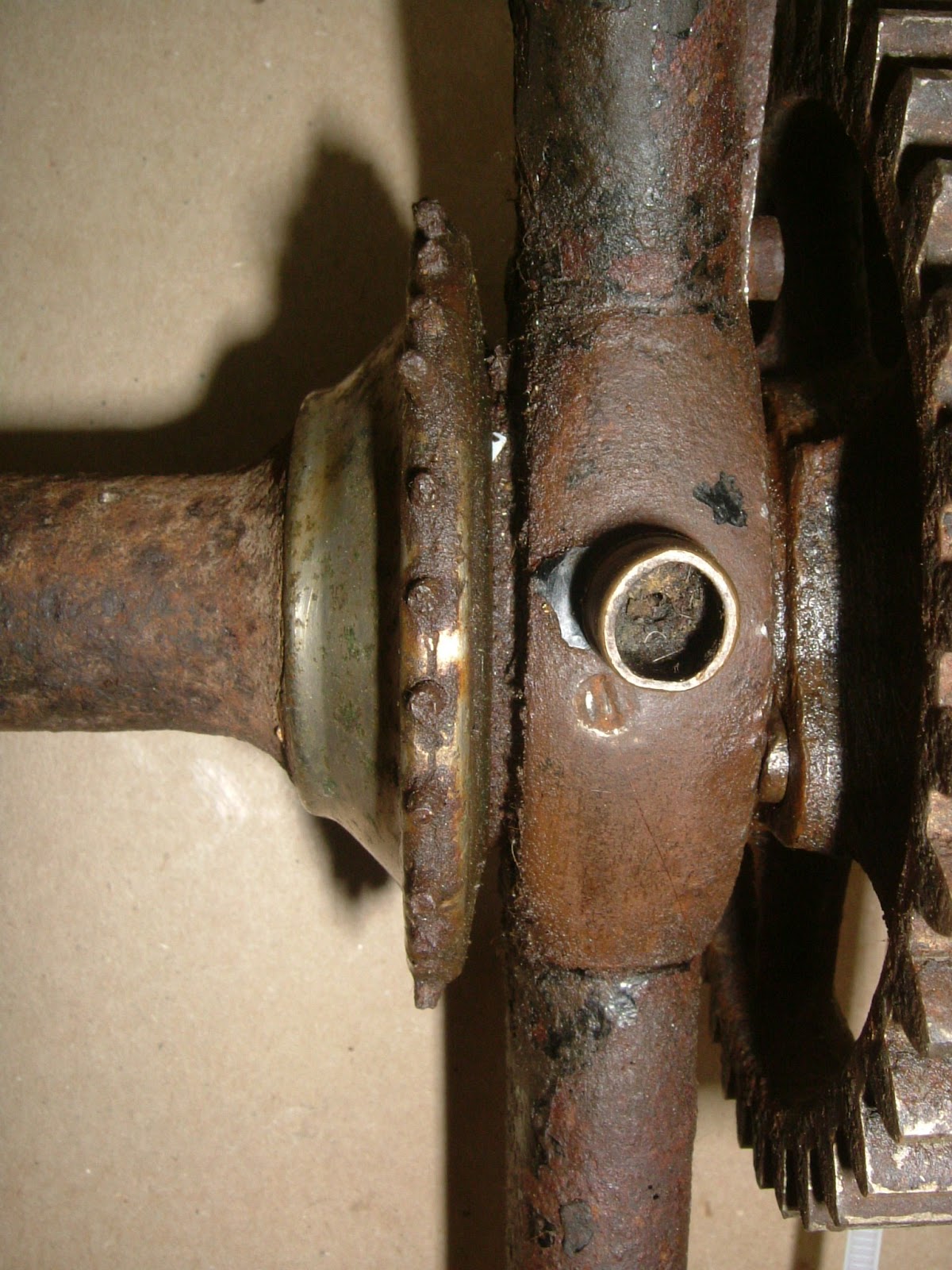
These pictures illustrates the key way, 
a tapered key fits into the shaped key way and is 
drawn up the matching taper on the hub by a locking screw. 

The original that I measured came apart very easily and has obviously been apart before as the tapered key and screw have both suffered at the hands of an enthusiastic hammer owner. The key (pardon the pun) to getting this kind of interface to work successfully is to have very close tolerances and as it turns out I had two attempts at the tapered key before I was happy. I may need to make another after everything has been hardened and plated, the tolerances are that tight.

The first job is to drill a hole that just grazes the edge of the bore 
and then countersink the outer end for the locking screw to locate in. 
I actually used two end mills for this job rather than a drill.

The next job is to flip the sun gear over and mill the back of the gear 
from the hole into the bore to create the key way. 
Note that the plug to bolt the gear to the vertical slide already 
had a recess machined out. This cut has to be at exactly the right depth.

Then we can machine the key itself, first job is to drill and tap
 a 1BA hole up the centre of a length of barstock. 
The original really was 1BA, I measured it very carefully.

Then without removing the work from the chuck, remount the chuck 
on the dividing head and mill away the excess to form the correct shape.

Finally, mill the 4 degree taper, this is where the size become super critical. 
With such a short taper, if the key is too tall you can't assemble it 
and if it is too short the key bottoms out as it is tightened.

Next make the locking screw, this is just simple turning and threading with two slots milled at opposite edges to adjust it. Of course, I also needed to make the special tool to do the adjusting...

Finally we can test the assembly of the lock.

Then I just need to make the blank for the planet gear, which is also just straightforward turning at this stage. All the fiddly stuff comes later.

Gear blanks ready for the teeth to be cut.


In other news, last weekend we had a local steam extravaganza at Steam Scene. I took the kids and we had an excellent time. A particular favourite being the miniature train rides which seemed to go almost to Christchurch and back. I was examining the gearing (for topical reasons, you understand) on a traction engine when the owner appeared and asked if I was "Claudia's Dad". It transpired that our respective daughter's were friends. During the course of our conversation, the geared facile came up. I enquired where she got her casting done locally and was referred to a small, local Christchurch foundry that should be able to help. I took my patterns and a photo of a geared facile around on Monday lunchtime. Well, again, it turns out we have mutual friends and had attended many of the same events together, we just hadn't met yet. The upshot is that my parts will be cast in steel and will be ready next Friday. I'll be sure to let you know how they turn out.

In more other news, On Sunday afternoon I helped an excitable, young Tinkerbell build her faux pathracer in my workshop. She arrived laden with Jaffa Cakes (I don't do this for free you know) and we proceeded to prep the frame before using vast quantities of my spare parts. Two of her chums from the local tweed riding scene, Dylan and Pete, also arrived and helped out. We finished it off, sans brakes, and she was able to ride it up and down the street before heading home very happy. She has since added some brakes. Tweed Pete also gave me a recommendation for a local gear cutter. I'll give him a ring tomorrow.

Wednesday, 15 February 2012

Bearing Adjustment Locks

Cleaned up silver soldered joints, the head will be plated later
and these require a little more work.

I've not had a huge amount of shed time this week although I have been able to clean up the brazed joints and make the little locking tabs for the bearing adjustment. These locate in grooves milled into the upper fork legs at the appropriate angle and width.

The depth is not super critical but I didn't want to
break through the tube wall so I had to be careful here.

The brazed joints all cleaned up easily but doing so showed up a slight movement in the non gear side bearing housing. This has clearly happened as a result of the heat, the housing are now not quite parallel. The discrepancy is very slight and doesn't seem to affect the bearing (I built it up to check) which is good because the chances of cold setting the 4130 forks is effectively nil, they are very strong.

I also drilled and tapped the holes for the oiler and inner bearing race locking grub screw (2BA & 4BA respectively). On the original these holes were very close. too close I thought so I cross referenced with some pictures I took of the racer in the Coventry Transport Museum. This famous machine has the oiler hole located much higher up and away from the grub screw, I have done the same and based mine upon the Percy Nix bike in Coventry.

The original facile I am copying has very close
holes for the oiler and inner race grub screw.

The holes on Percy Nix's racing machine are farther apart.

I've based mine upon the Coventry machine.

A good view of the grub screw and the oiler in place. 
The Coventry bike is missing it's oilers, this oiler is missing it's cover.

The locking tabs are asymmetric in that the one on the gear side is longer than the non gear side, this is so that the bearing can still be adjusted with out removing the gear from the hub. I did consider machining them but decided that the set up would take longer than careful hand filing.

They're tricky little things, the inner edge is a curved 45 degree bevel 
and then two notched are filed into this to produce three teeth 
to lock into the castellations on the outer bearing race.

My stock of 4BA cheese head screws is a little low, 
hence the rusty one used in the picture.
 BA screws are all but unobtainable for sensible money in NZ 
so I'll either make or import some myself.

Next week I'll hack into a large chunk of Gunmetal (LG2 bronze) and start the spoke flanges for both wheels. Gunmetal machines beautifully so I'm really looking forward to this.

In other news my parents, both keen gardeners, have been busy in our garden. When we moved in many years ago we found an old greenhouse hidden in one corner of the garden. My parents have now dismantled this to allow us to move the compost bin to somewhere where it may actually work. My father has about a dozen greenhouses himself but I'm unsure how he's going to fit mine into his suitcase when he leaves. I'm sure he'll try.

An amusing incident happened at dinner the other night, the children were running through all the languages that they knew how to say hello in. After the obvious English, French, German, Spanish, Maori & Japanese, my daughter upped the ante with Gaelic. "Pogue Mahone" she proudly said. I nearly spat my tea all over the table, having shared a house with a native Gaelic speaker at University I happened to know what this very useful phrase actually means. I suspect that an unknown Irishman has been having a little fun at the expense of my Daughters teacher. Apparently the class all solemnly repeat the phrase in that special monotone that children the world over reserve for "Good Morning Teacher". My daughter was very embarrassed when I told her what it meant, whilst my son was busy writing it down. My parents were not amused in that very Victorian manner.

Thursday, 9 February 2012

Brazing the Front Forks

As promised last time, I've been directing my efforts at getting the front forks brazed up. There seemed to be an endless list of things to do before I could light up the oxy-acetylene though. I needed to hollow out the stubs that extend into each of the tubes. As mentioned before this is for several reason, firstly it helps to prevent cracks forming at the junction of the stub and the tube. Secondly it makes the brazing process easier as a large mass of material that is hard to heat is removed, this helps to prevent overcooking the tubes. And last is the obvious weigh loss from removing metal. In this case, hollowing out the 6 stubs (2 per 'knee' and 2 on the head) removed a pound of weight (0.45kg). Not insignificant.

However before I hollow out the stubs, I need to stamp the top of the Abingdon Ball Head with the appropriate patent information. I need the stubs to be solid to support the hammer blows required to do this. I admit to putting this task off for ages, the potential to completely screw it up is high. Every now and again I'd have a little practise on some scrap until I had developed a method of working that reduced the chance of errors. I was still shaking when I struck every letter and number though. The hard bit is to get the individual letters to be correctly aligned vertically with respect to each other and correctly spaced. My method is simple, I use 4 layers of masking tape to define the lower edge of each letter or number, placing each stamp onto the surface of the workpiece and then sliding until it contacts the ridge of masking tape. With practise, it becomes easier to apply the same pressure against the tape and the letters then line up with each other. To get the spacing correct, I mark the tape ridge at the correct intervals and then line up each stamp with the next mark.

It is worth noting that letters or numbers with less area, such as I and 1, require a lighter blow
 other wise they appear over struck compared to larger letters.

The results aren't too bad although the I is too far to the right,
I'm not too bothered as the original is also clearly hand stamped.

With this onerous chore out of the way I can now hollow out the stubs. I very roughly drilled and milled out as much material as possible before getting stuck in with a carbide burr mounted in an air die grinder. I bought a cheap Chinese die grinder that will run at 25,000 rpm without over running my compressor too much. Think of a dentist's drill on steroids. You really do need those high rpms when removing steel. It is a truly horrible job and results in thousands and thousands of razor sharp needles of steel *everywhere*, regardless of how carefully everything else is covered up. I've been digging steel splinters out of my fingers (and feet!) ever since despite wearing a ridiculous amount of PPE.

Roughly removing as much material as possible...

...before getting the carbide burr out


A pound of steel was removed from these 6 stubs.

Now I need to make a jig to hold everything in the correct location whilst the heat is applied.

I happened to have some angle iron in my magic cupboard, so this got chopped up... 

...and with some 10mm threaded rod, I can locate all the bits in a frame that doesn't move.

I used 40% silver solder to keep the heat on the 4130 chromoly tubing down. Silver solder has suddenly got really expensive, still I only need the one kidney. It all appears to have been successful with good penetration into the joints and very little distortion from the heat, although one of the blanks in the bearing house was *very* hard to get out afterwards. Fortunately I had previously made a 1.75" x 26tpi tap and had it hardened for exactly this eventuality and I was able to clean out the threads nicely.

This week I'll clean up the joints and mill the slots for the locking tabs. Then I can continue with the gunmetal flanges. Then I can make the spokes... etc. I've set myself a goal of having the frame sat on it's wheels inside of a year. I'm already 6 months into the project and more or less on track.

In other news, I've finally managed to arrange a small aftershock for my parents, We were having dinner in Christchurch and were rudely interrupted by a vicious little 4.6, I don't think they liked it much. We also had a nasty little swarm last night but fortunately my parents are away on a tiki tour of the West Coast this week. I'll try and save a few for their return.

In more other news, someone seems to have stolen summer this year. We haven't had one yet, does anyone know where it is?

Saturday, 28 January 2012

Harden the four cup(s) *

I've been able to get out in the shed a little this week. Enough to fettle the rear hub from a bar of 4140. When I checked the drawings I had made back in 2008, I was certain that I'd made a mistake measuring the original and that I'd got the dimensions too small. I even checked a couple of 1890's front wheels I have lying around which confirmed that the measurements were correct. The bearings seemed tiny when compared with the large front wheel bearings, but are exactly comparable with a modern front wheel.

The first task is to make the hub shell, this uses the same techniques as in the front hub just on a smaller scale and with fewer bearing surfaces (!). There is no need to mill key ways to lock the gunmetal flanges in place since the rear hub transmits no torque. In practise I have found that the spoke tension will adequately hold the flanges in place, however I will either make them an interference fit or soft solder them on as was the norm back in the day. The oiler hole is tapped at 2BA, I'm happy using BA threads since they were first formulated in the 1880's and I have previously found them on antique bikes.

The next job is to make the cones, the fixed (right) cone is left smooth but the adjustable (left) cone is knurled with a straight, fine pattern. My knurling tool has diamond pattern wheels and with the shocking local price of replacement wheels, I've milled 80 'knurls' instead of rolling them.

Roughing out one of the cones

Parting it off.

Machining the outside face.

Milling the 'knurls'

The hub spins beautifully on it's 11 x 3/16" balls in either race. 

I've calculated a formula for the dimensions of the race based upon the number and size of balls required, this has worked out well so far although the formula leaves no room for a gap in the balls which they need. You can either add one to the number of balls (n) or just add a smidgeon to the calculated value D. I have found that making D larger by 0.020" or so is enough to get a useful gap. The calculated value for D in the rear hub = 0.1875/sin(180/11) + 0.1875 = 0.853". In practise I machined it to 0.875" and have a sufficient gap, as can be seen in the above photo, so the balls don't bind.


With all the steel components of the hubs now complete, I can get them heat treated. I initially chose 4140 steel because of it's suitability for nitriding which produces a very hard surface case up to Rc 64 but retains the tough centre. Nitriding will also cause far less distortion due to the lower heat required. SSM have a local office so I gave them a ring in the morning and was told that if I can get the parts to them by 10 o'clock they could put them in today's batch and I could pick them up in the afternoon. A fantastic service, I'm sure you'll agree.

The parts were still warm when I picked them up, 
like fresh hot cross buns straight out of the oven, only not as tasty. 
And a bit harder.

In other news my parents are now here and are pleased that I've been unable to organise any large aftershocks so far. My Dad is being kind to me and has only offered advice on using the dividing head to date. He sits on the stool in the corner of the workshop like a benevolent owl. I'm going to try and get the forks brazed up whilst he's here. He has far more experience than me at brazing, so I'll get him to do it and then I can examine his work. This will be the focus of my shed time next week.

We had a huge electrical storm at the weekend, It passed directly over our house and we suffered a very close lightening strike. Had I any hair remaining I'm certain it would have stood on end from the electrickery. My wife's new computer (birthday present) had it's motherboard fried and we are trying to arrange a repair on insurance. What fun. In the meantime I've resurrected an ancient steam powered computer to allow us to access the interweb and me to continue posting this nonsense.

* with apologies to Chopper Reid

Wednesday, 18 January 2012

The Front Hub

I've spent a little time this week making the front hub for the facile. This is a complicated affair and has 6 bearing surfaces that must all be concentric. It is hollow and has several holes and ramps that all need to accurately located. Lots of 4 jaw and fixed steady use.

Once again a series of photos to illustrate the various processes, click for larger versions.

Centre the ends, machine a plain surface to use the fixed
steady on and bore a pilot from either end. The pilot holes
met accurately (not too easy with a 7" bar)
Cut the first pair of bearing surfaces,
the end of the hub is also now at final size.
Now enlarge the bore to final size from this end.
Then machine the inner bearing race and clean up the bore,
These three bearing surface are now all concentric.
Now flip the hub around and repeat on the other end.
The centre section needs to be thinned to size.
Like this.
Then all that's left is to drill the holes to poke the balls through,
mill the key ways to lock the gunmetal flanges...
... and mill the angled ramp that is used to lock the sun gear to the  hub.
Finally after all that I can trial a fit up with all the parts assembled.
The hub spins beautifully on it's 60(!) balls.


In other news, my parents are arriving for an extended holiday with us. This has meant a flurry of activity around the house. The workshop has been tidied, the garden weeded, the lawn cut and the children polished. I only hope that the work so far on the geared facile bears Dad's scrutiny. I just know he'll be out fiddling with stuff whilst I'm at work. I'll have a word with Mum.

I reported last time that I didn't feel the magnitude 6.0 aftershock as I was riding home at the time. It appears that I did feel it, I just didn't realise it. On the way home I had caught up with a mate of mine, another local cyclist, at a set of traffic lights. Matt has a new fangled bike computer that does GPS stuff as well as speed etc.  I'm a retrogrouch and only need a calendar to calculate my average speed these days. This means that given the exact time of the 6.0 from geonet, he was able to work out very accurately where we were at the time. At the spot in question we were almost home and on a very wide straight road so we were riding two abreast and chatting. I remember that very suddenly we clipped handlebars for no reason, I dismissed it as either Matt, myself or both of us being a crap cyclist. Now Matt's a handy rider so that just left me. I'm just glad that my ego is intact.

Wednesday, 23 November 2011

An Act of Dog

This week has been momentous in that I now have the first assembly complete. I've finished off the head to the point where I can fit the forks legs to the head, the knees to the fork legs and the lower legs to the knees. Everything jiggles nicely with no stress to hold it all in place, so hopefully when it is brazed up it will stay where it should without too much distortion and misalignment from the heat.

The'axle' is just a machined spacer to hold everything square and concentric
However let's not run before we can walk. There has been a lot of hand work this week underneath the head to clean it all up. As before here is a series of photos when I remembered to take some.


The mounting point for the front brake pivot has also been machined, this required some careful trig. to calculate the angle and depth to ensure that the hole didn't break through either below the head or into the central bore.

I've tapped it at 1/4" bsf, I wanted to use 1/4" bsc but I didn't have a plug tap in that size.
I've rootled around in my magic cupboard to find my stash of silver solder and failed miserably. I suspect that my wife has been funding her extravagant lifestyle by discreetly selling it on the local black market. Or I probably just used it already. I did find lots of skinny silicon bronze brazing rods though, so maybe I'll just use that to glue it all together instead. I'm undecided if I'm going to finish the lever pivots before I braze it all up or if I braze up what I have completed already. What do you think?

My workshop and lathe need a major spring clean after all this work on the head. Recall the original billet I started with that weighed 18lb 3.5oz (8.26kg). The machined head now weighs a svelte 2lb 1oz (0.93kg), so I have 16lb 2.5oz (7.33kg) of swarf and filings lying around (mostly in one pile). My wife is getting grumpy when I bring it into the house on my feet so clearly a clean up is needed in order to maintain certain marital benefits.

Next week I'll finish off the casting patterns and then decide what to work on next.

In other news, a few of us rode the Little River Rail Trail at the weekend, We rode from Motukarara to Little River, had a picnic lunch and then rode home again.

Motukarara
'04 & '06 Royal Enfields. The wagon has a wooden chassis and  is older by 25 years.
Little River station building
It was a beautiful day that turned into a roasting Nor'Wester. On the way back, we were riding straight into the teeth of the gale (of course). The kids did really well and both rode the full 45km, the longest ride for both of them. Less fortunate was another youngster that hit a rock next to Lake Forsyth, wobbled and then plummeted 5 metres down a rocky bank and into the green, algae filled water. She disappeared from sight underwater, all tangled up in her bike, but quickly resurfaced. Fortunately we witnessed her disappear so were on scene very quickly and I was able to scramble down the rocks and jump in to assist her out of the toxic soup, She was miraculously unhurt other than bruising, just very scared and shaken. Her bike was badly damaged but she had clung on to it in the deep water and I was able to fish it out. I've since heard that she is all OK which is wonderful news. I confess to having a wee drink that night, I'm not a great swimmer.

In more other news, I've taken another tumble off my bike, the second in 10 days. Commuting home through a park in Christchurch, I was JRA and about to overtake a pair of elderly ladies walking their dog. I'd pulled well of the tarmac path and onto the grass so I would pass without scaring them. As I'm level with them, their dog very suddenly turns sharp left and runs straight under my front wheel. Fortunately, I landed on the same side as last week so I just freshened up my existing gravel rash and re-wrenched my back in the same spot. The ladies were very apologetic and concerned but after I'd been able to get up and straighten the bars etc. I pointed out that it wasn't really any one's fault and there was no real harm done. It was just one of those things, an act of Dog.